
Boomers and Millennials Part II (Craig Wong 8/9)

CRAIG WONG, AUGUST 9th, 2020
[11 MIN READ]

In Part I, I introduced the notion of “perichoresis” as a way to understand the Trinity as a dance among three distinct yet co-equal persons, Father, Son and Holy Spirit. We can thank the Cappadocian brothers, Basil the Great, Gregory of Nyssa, and Gregory of Naizanzus, and other patristic theologians of those early centuries who did the heavy lifting of bringing understanding to the deep mysteries of the Triune God.

The Eastern Orthodox tradition, in particular, has carried the ball regarding the richness of trinitarian theology, for instance, the great 7th century theologian, John of Damascus who explored the inter-woven nature of the three-in-one God, a relationship of deep and abiding intimacy. The language of perichoreo, or an orchestrated dance in the round, is found in their writings. Such imagery captures the essence of what has been termed, “social trinitarianism” which understands God as a community (I love this), and explains why we, as those created in Godʼs image, are also designed to live in communion with one another. But more than the trinity being a mere “model” for us, we are drawn into the life of the Father, Son and Holy Spirit.

For me, this perichereo surfaces in breathtaking form when one looks at the latter chapters (14-16) of the book of John, where Jesus teaches about the ministry of the Holy Spirit to his fear-filled disciples: “The Holy Spirit, whom the Father will send in My name, will teach you everything, and remind you of all that I have said to you...Abide in Me, as I abide in you...As the Father has loved me, so I have loved you; abide in my love. If you keep my commandments, you will abide in my love, just as I have kept my Fatherʼs commandments and abide in his love....When the Spirit of truth comes, He will glorify Me, because he will take what is mine, and declare it to you. All that the Father has is Mine. For this reason I said he will take what is Mine and declare it to you. If you ask anything of the Father in my name, he will give it to you. Ask and you will receive, so that your joy may be complete.” Iʼve shamelessly compressed the text, but the picture I am trying to paint here is one of Holy collaboration between Father, Son and Holy Spirit, and one into which we are being lovingly invited into. I begin with this to punctuate our need to imbibe our intergenerational efforts with a theological imagination. Youʼll recall that I described the interactions among Boomers, Millennials, Gen Zʼers, and Gen Xʼers as being like an awkward dance. We need to be encouraged that the Father, Son and Holy Spirit are committed to helping us learn how to dance better. I want this to be the foundation as I engage some of the inquiries that came up from our last conversation:

I grew up in a Chinese American immigrant church and the first-generation / second-generation divide was deep. It wasnʼt until I grew up and experienced white American evangelicalism directly (through private Christian school) that I realized how much Chinese first-gen values (as well as American evangelical values) were tied up in what I learned at church. I wonder all the time: What would have happened if my peers had had the opportunity to experience Jesus free of and separate from their parentsʼ ideas that they were rebelling against?

If only any of us could be “free and separate from” anything, right? Thereʼs lots to unpack here, but each of us will be spending a lifetime realizing who we really are, or more importantly, who weʼve been called to be, apart from our checkered pasts. “Checkered” sounds negative, but itʼs important to note that when something is “checkered” it means that our pasts comprise not only bad things, but also good things. This is true of White American evangelicalism, Chinese immigrant culture, and all our parentʼs strange, syncretist ideologies. I wish I could say Iʼm passing on a faith to my kids that was free from cultural and theological baggage, but this would be to live in pure and utter delusion. So hereʼs the perichoretic hope. Regardless of what we need deliverance from (and we all need deliverance), we are invited into something big and transformative.

How do we work with intergenerational tensions around differences in Christian ideologies in the Church. The image of “being Christian” has continually evolved. “Collective theological interrogation of American Christianity” Ooh, how do we do this well?

I know this wonʼt sound that compelling to many of you (and really compelling to some others of you), but learning Church history really matters. I say this because tensions around Christian “ideologies” (or, insistently, theologies, missiologies, ecclesiologies, the list goes on) has been part of the landscape since the day Jesus came on the scene. Itʼs helpful to remember this. Every generation in every time and place has had to wrestle with what it means to be a Christian and what it means to be the Church. This will be true until the day that Jesus returns. Now even hearing me speak of the the 2nd coming of Christ might trigger “White Evangelicalism!” to some, but this is one of the core tenets of orthodox Christianity. This is why, over the centuries, the Church has from time to time had to come together and labor over the creation of various creeds and confessions because of the need to remember who they are, what they believe, and what it means to be a Christian in the midst of competing messages and sub-gospel (idolatrous) narratives. This has usually involved the need to scrutinize and question (“interrogate”) their own ecclesial contexts (think about Luther and the Catholic Church). What holds most all historic creeds and confessions together, however, is a fundamental Trinitarian orthodoxy. Part of interrogating our own ecclesial context “well” is to be purposeful in grounding the conversation in orthodoxy, rather than secular ideology (whether conservative or progressive), and then come at it with theological and relational humility. Not everyone will be able to do this well.

I am wondering about what the non-millennials/Gen-z are wanting to accomplish when they are asking to learn from the younger generations. Even with all that knowledge, what is the goal? How are young people a part of that conversation? What are both groups (older and younger) wanting to learn from each other? What are the things that they donʼt understand?

The question of motive is critical, isnʼt it? I agree. What is their agenda? How are they going to use the information they get from us? Such concern is profoundly reasonable in this age of data-mining where weʼve discovered that, for the Googles and Facebookʼs of the world, we are actually not the consumer, but rather, the product. This question gets to the heart of trust, which essentially can make or break the inter-generational possibility. I actually want to call attention to the fact that there are older folks that are even asking to learn about the younger generations at all, i.e. that their interest in young people can go beyond the need for baby-sitting! So I canʼt speak for all old people, but I can speak from the circles Iʼve had privilege to gather with: They want to learn from the younger generation because they love Jesus, they love the Church, and they know that the health and future of the Church depends on young and old working on this together. Once again, this involves much humility, both relationally and ecclesially, for example, the humility to acknowledge that thereʼs ways weʼve done “church” that have not met emerging generations well.

Regarding the things we donʼt understand (of each other), there are plenteous things: how we see the world, what “church” means, what we assume of each other (“Theyʼre not interested in what we think”), our relationship with technology (which frankly doesnʼt seem all that different generationally), what relationships look like, our greatest fears and anxieties, the list goes on.

As we are willing to “step onto the dance floor” so-to-speak, and engage with one another with humble curiosity, there is the possibility for trust. And trust is critical in our attempts to come together and truly make progress in being the kind of Church that truly glorifies Christ in our world. We can together boldly participate in the Triune community of which, and for which, we were made. A community of deep and abiding love, trust, mutuality and interdependence. Howʼs that for a compelling alternative to Eurocentric racial capitalism?
Volunteering at GFCC Food Pantry this Summer

There are many Saturdays available this summer for volunteers to sign-up to serve at the Grace Fellowship Community Church Food Pantry. They regularly invite folks to come help package and distribute food delivered from the San Francisco-Marin Food Bank.

  • Address: GFCC (3265 16th St, San Francisco, CA 94103) in the Mission District

  • Time: meet approximately 11:45am to package, distribution around 1:30pm, and end around 2:45pm (no need to stay the entire time)

  • Please wear a face mask and close-toed shoes

  • Sign-ups for particular weeks

More info can be found here, or you can message the coordinators for the given week.

Boomers, Millennials, Let’s Dance! (Craig Wong 7/19)

CRAIG WONG, JULY 19, 2020
[9 MIN READ]

Think about a wedding reception when the aging father, and then the young groom, finish dancing with the bride while the love ballad draws to a close. The vibe pivots and pulsating R&B tunes fill the hall. Young adults are the first to broach the dance floor. After some coaxing, a few wall-flowers follow suit. Itʼs an awkward affair, especially when the middle-aged men activate their inner-groove from the 70s and 80s. Initially, folks clump by generation, eyeing each other with amusement. But soon, teens, toddlers, seniors, and everyone in between, mix it up, executing the “electric slide” in clumsy-yet-poetic unity.

Itʼs been thought-provoking these days, to see intergenerational bridge-building as a subset of the Triune Godʼs redeeming work of reconciling all people - Jews and Greeks, slaves and free - into the one body that God has always intended. The imprisoned Paul, while writing to the Ephesians, speaks of this work as “the mystery hidden for ages in God who created all things, so that through the Church the wisdom of God in its rich variety might now be made known to the rulers and authorities in the heavenly places” (Ephesians 3:10). This was the same apostle that implored a woefully divided congregation in Corinth to remember that they were baptized in one Spirit and, therefore, were parts of one body that needed each other, i.e. the “eye cannot say to the hand, I have no need of you, or again the head to the feet, ʻI have no need of you” (1 Corinthians 12:21).

Thus, Boomers cannot say to Millennials, I have no need of you, or Gen-Zʼers cannot say of Gen-Xʼers, I have no need of you. On the contrary, their oneness is critical to the Churchʼs witness before the powers and principalities of which Paul speaks. In other words, the interdependency of young and old is more than a heart-warming sentiment. It is a missional imperative.

Looking back, Iʼm seeing how Ekklesiaeʼs priority for generational bridge-building was sparked at my 50th birthday party eight years ago. Seeing my first mentor, Rod Jung, I remembered with fondness how he came alongside me as a new believer, taking interest in my life. I asked myself, “Who am I coming alongside? How purposeful am I with my own kids?” Also, that year my father was rapidly succumbing to Alzheimers. Spending many hours by his side, I began to practice being truly present, to ask questions, to engage in conversations that weʼd never had. This spurs me today to engage the Churchʼs octogenarians and nonagenarians, the so-called “silent generation,” that their wisdom and experience be passed down to our young.

When New Zealand lawmaker, Chlöe Swarbrickʼs “OK Boomer” retort went viral last year, the spike in generational-adversarialism highlighted just how fragile the level of trust - and how deep the divide - can be between any two human communities. Ironically, this reality is also what made Ekklesiaeʼs recent work among believing Boomers and Millennials all the more encouraging. In our Gen Y conversations, emerging leaders - across the board - expressed their genuine desire, in fact, need for older mentors, whether Boomers, Gen Xʼers or beyond. “We want them in our lives,” they said in so many words, “but we also need them to be more self-aware, more humble. We donʼt need their religious certitude as much as we want to hear about their lives of faith. What was it like to be Christian during the Vietnam War or the Civil Rights Movement (the Boomerʼs BLM). How was your faith challenged and transformed in those days?” Sadly, such mentors have been missing in action. As one Millennial put it, “the only time older congregants reach out to me is when they need babysitting.”

This led us to host groups among Boomers and ask the question, “What are the obstacles that inhibit you from reaching out to emerging adults?” While a common response was the perception that their influence was unwanted, there was an overall absence of excuses. Instead, there was remarkable self-reflection and vulnerability, the very posture that Millennials wished more prevalent among Boomers. What are the attitudes and assumptions we hold onto that make it hard for young people to connect with us? How am I letting my perplexity about young peopleʼs mode of communication, their freedom to bare all on social media, their aversion to church, intimidate me? And how are ways we do church that hinder, rather than develop, the discipleship of our young people? Other-generation “flies on the wall” listened and reflected back on what they observed. The reports were very encouraging. Mutual interest in each other was greater than previously assumed. Trust and relationship was possible!

Which brings us back to the Triune God. The Ephesian text, as with all of Paulʼs letters, captures the collaborative nature of the three persons of the Trinity: God the Father calls, Jesus delivers, the Spirit reveals. Patristric theologians of Orthodox tradition, described the co-equal dynamic of the Trinity as a perichoresis which literally means “a circular dance.” Many paintings depict this celestial frolic, illustrating that God is a community! We are invited into this joyous choreography! Does it help you to think about generational bridge-building as an opportunity to experience the Divine Dance?

The Corinthian text implies that the generations “need each other.” There are many ways, but let me suggest three. Firstly, the landscape of Eurocentric racial-capitalism is profoundly complex, and will take not only the “wokeness” of the young, and the historical perspective of the old, but also a collective theological interrogation of American Christianity toward a more faithful gospel witness. Secondly, weʼre going to need each other as the politicized pandemic spells frightening trouble ahead. Lastly, we can practice crossing cultures as the gospelʼs reconciling work. Intergenerational bridge-building is a “low-hanging fruit,” yes? If we can do this well, weʼll be better equipped to venture across the much deeper divides of Church and world.

Let's dance, shall we?

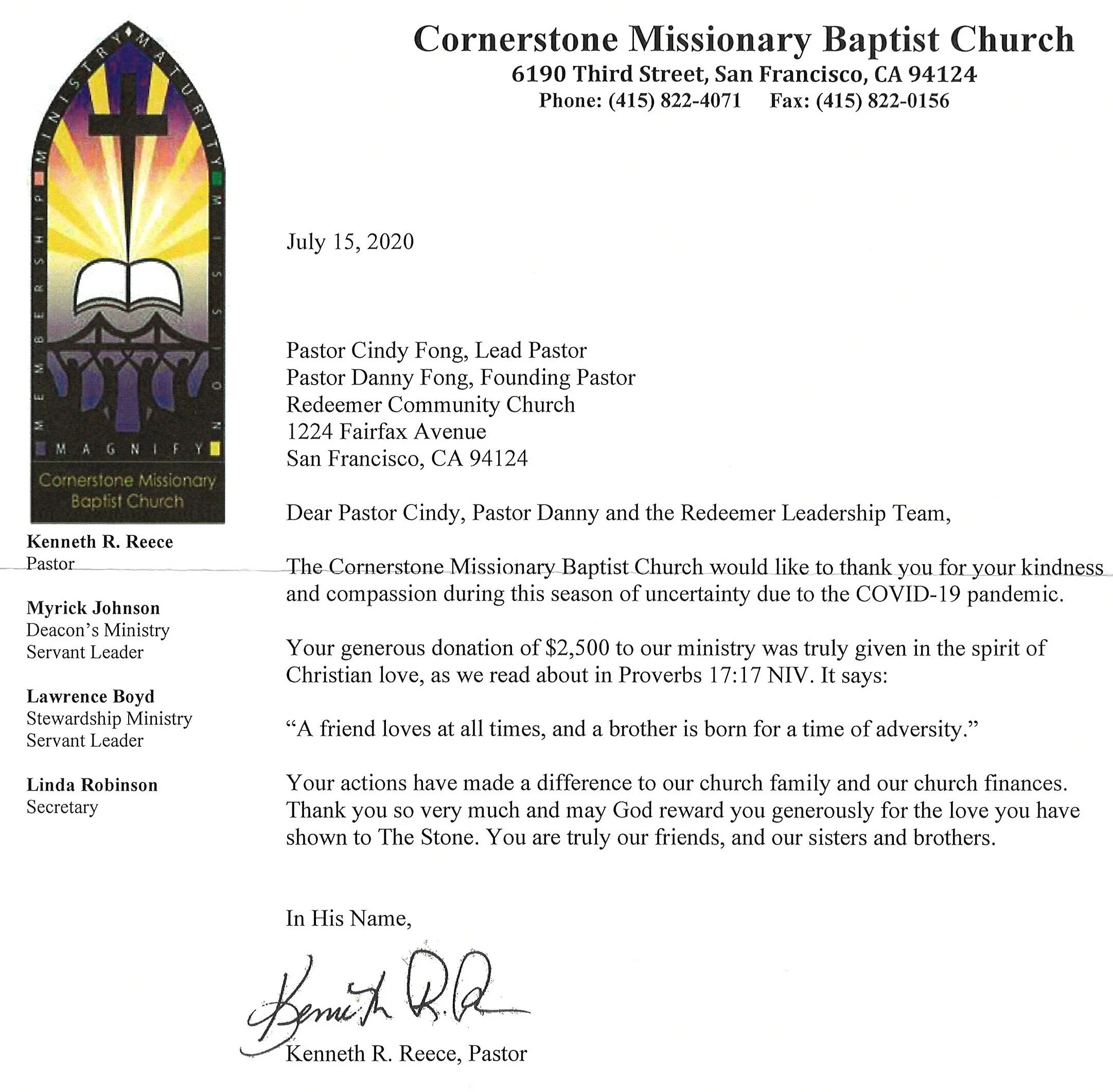
Redeemer Pandemic Fund Update (July)

So far $18,800 has been given from the Redeemer Pandemic Fund to 13 nominees (4 organizations, 1 individual, and 8 families).  This includes:

  • Shekinah Christian Fellowship’s Deacon Fund

  • Rising Immigrant Scholars through Education at Berkeley

  • The Penadas (Ministering with InnerChange in Honduras)

  • Golden Valley Camp (where we have our youth retreat

  • Several Rise families were also recipients.

If you would like to continue to contribute to the Redeemer Pandemic Fund, you can send a check to Ed McKelpin (with memo: Redeemer Pandemic Fund) at this address:

Ed McKelpin
4124 Folsom Street
SF, CA 94110

You can see a video of thanks from the Penadas and InnerChange here:


Video Support Project for San Quentin (48 Hours Left)

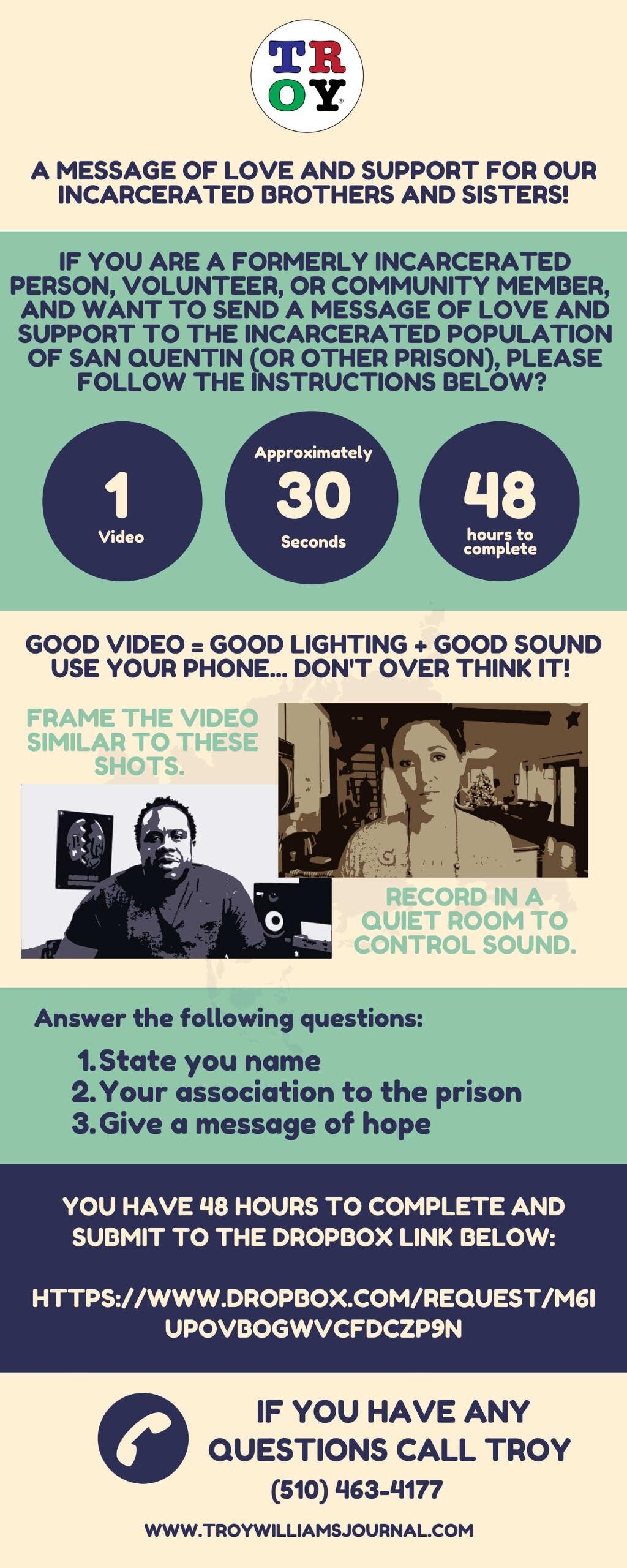
At the request of Troy Williams, former member of Brothers in Pen and current Soros Justice Fellow and journalist. He is gathering 30-second videos in support of those incarcerated during this pandemic, and is working on a way to get them seen by those inside. Would any of you like to make one? Do it quick!'

Below is Troy's flyer for more information. The live link for uploading is here:  https://www.dropbox.com/request/m6iuPOVBogWVCfDcZp9n

Please call or text Troy for more information: 510-463-4177.

Troy's video support.jpg

For an informative and heartfelt commentary on the situation at San Quentin, read this article by Jody Lewen, Executive Director of Prison University Project.

If you're interested in some more resources about the SQ catastrophe, you can find some here.

Susan from Sunrise Ministries in Cambodia 7/9

Susan from Sunrise Ministries in Cambodia sends us this updateWe can continue to be in prayer with them: 

The Cambodian government policies combined with the hot season hot heat successfully halted community spread of the coronavirus.  Friends working in medical fields and in the provinces seem to be confirming this. Don’t mean to gloat but everyone is back to work like normal, including our team and our Sunrise staff.  We aren’t sure how long this will last because the temps are cooling now for rainy season, and the airports are open.  Pretty tough to get in though, and the government quarantines the whole airplane if any passenger tests positive on arrival.  Basically we can’t leave if we intend to come back, and we’re glad to be here.  It is very surreal when we see the news worldwide.  We are thanking God for his mercy.

Although the economy is open, there are serious difficulties as our two largest industries have been significantly impacted.  Tourism has shrunk to near zero, and the garment industry is sinking fast.  This leaves many without any income.  Everything is lessened, even purchases from the guy that sells steamed eggs from a cart, or the one selling grilled chicken wings on the roadside (one of our clients makes the eggs to sell, and another makes bamboo skewers for the wings.)  Schools are closed through November (the next school year).  Prices for food are higher and the Prime Minister has been encouraging home farming on TV and Facebook.  As a result, Sunrise has increased rice distribution to our clients for the foreseeable future and we may discuss gardening at our next client meeting.  We are looking at ways of funding rice, including selling some unused furniture.

On a happier note, Sunrise is looking for ways to keep kids profitably occupied.  We’ve found some creative games that kids can learn to play—then make their own versions.  Our staff’s daughter helped us test out a game. The kids in the village loved it too!  Smiles all around! This game allows students to get creative with whatever math they’ve learned, from early elementary all the way up to calculus. We’re going to make a booklet describing these activities and pass it around to all our kids, as well as other organizations.

Thank you for your continued love, prayers, and partnership!

Susan and the Sunrise staff

Rise Prep Update 7/8

On behalf of the families at Rise Prep who received aid through the Redeemer Pandemic Fund, we want to say thank you for your generosity and care! We are grateful for your partnership that takes on tangible expression in the lives of our students and families.

While we are still working out the details for next year, thanks to Dayspring, we will be using their office space for the first semester next year. This will allow for students to be socially distant for in-person classes. We will also be using the nursery for storage and the social hall for teacher prep. We will keep you updated on these plans as the summer progresses. 

We want to thank Roy and Susie for their help with shopping for and setting up breakfast and snacks each week for the Rise students! Next year though, we will need new folks to help out with snack buying and prepping. If you are interested, please contact Juliette.